
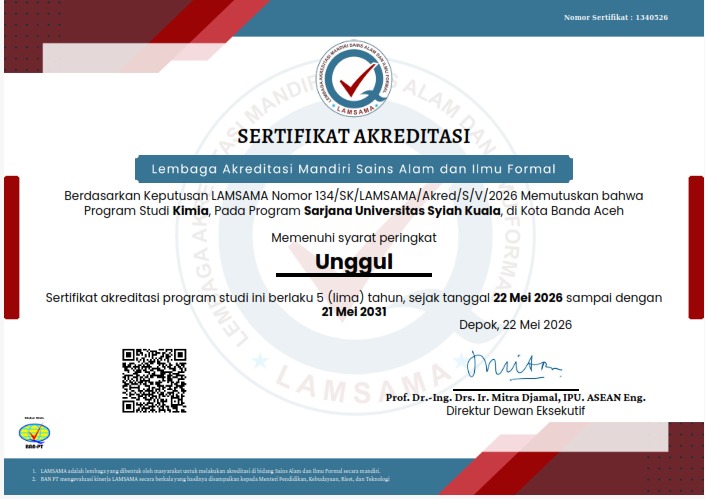
Banda Aceh – The Undergraduate Chemistry Study Program, Faculty of Mathematics and Natural Sciences (FMIPA), Universitas Syiah Kuala (USK), has officially achieved Excellent Accreditation (Akreditasi Unggul) from the Independent Accreditation Agency for Natural Sciences and Formal Sciences (LAMSAMA). This achievement marks a significant milestone in the program’s continuous efforts to enhance academic quality, governance, and educational excellence.
The accreditation was granted based on LAMSAMA Decree No. 134/SK/LAMSAMA/Akred/S/V/2026 and is valid for five years, from May 22, 2026, to May 21, 2031. The recognition reflects the study program’s strong commitment to maintaining high standards in teaching, research, community engagement, and academic management.
Prior to receiving the accreditation result, the Undergraduate Chemistry Study Program underwent a comprehensive field assessment conducted by LAMSAMA on April 27–28, 2026. The two-day evaluation served as a crucial stage in assessing various aspects of the program, including curriculum implementation, faculty qualifications, research productivity, student achievements, quality assurance systems, and institutional governance.
The successful attainment of the Excellent Accreditation demonstrates the collective dedication and hard work of faculty members, students, alumni, administrative staff, and university leadership in fostering a culture of continuous improvement and academic excellence. It also highlights the program’s readiness to meet national quality standards and compete at both national and international levels.
As one of the leading academic units within FMIPA USK, the Undergraduate Chemistry Study Program continues to strengthen its commitment to producing highly competent graduates, advancing scientific research, and contributing to societal development through innovation and community service.
This achievement is expected to further enhance the reputation of FMIPA USK and Universitas Syiah Kuala as a center of excellence in science education and research, while opening broader opportunities for academic collaboration, student mobility, and international engagement in the years ahead.